Article: Go Tell the Spartans: The Monument, the Words, and the Assignment That Never Expires
Go Tell the Spartans: The Monument, the Words, and the Assignment That Never Expires
Go tell the Spartans, stranger passing by
That here, obedient to their laws, we lie.
Most people who know those words have never stood at the pass. The monument at Thermopylae sits off a Greek highway, overlooked by tour buses heading to Athens, next to a parking lot and a gift shop. The stone is unremarkable. The inscription is a recreation, the original vanished two thousand years ago. The coastline has shifted so far since 480 BC that the narrow choke point where the Spartans held doesn't exist anymore. Centuries of river silt pushed the sea back nearly six miles. What was once a killing ground fifteen meters wide is now an open plain.
You have to work to picture it. But the stone is still there, and the words are still being argued over, and the men they describe are still waiting for someone to deliver the message.
The pass is not what you think it is
The name comes from the hot springs, thermopylai, the hot gates. They still flow today at around 40 degrees Celsius, sulfurous and blue-green, at the base of Mount Kallidromos. In 480 BC the road squeezed between those cliffs and the Malian Gulf. At the narrowest points, the pass was perhaps fifteen to twenty-five meters wide. Not a battlefield. A choke point, the kind of ground where numbers stop mattering and only the men directly in front of you can reach you.
Leonidas was approximately sixty years old when he led the 300 there. He was a third son who had come to the throne late, after his half-brother died without heirs. He understood the ground. Before leaving Sparta he selected his 300 specifically because each man had a living son. This was not romanticism. It was a commander making provisions for what came after.
They held the pass for three days.

Who actually stayed
Here is what the popular story leaves out: roughly 1,100 Greeks died at Thermopylae, not 300. Alongside the Spartans stood 700 Thespians under their general Demophilus, virtually the entire fighting-age male population of their city. Unlike the 400 Thebans, whom Herodotus says Leonidas held at the pass under suspicion that their city would collaborate with Persia, the Thespians were there entirely by choice. Herodotus records it plainly: they said they would not leave Leonidas and those with him. They stayed and died.
Xerxes burned Thespiae afterward. The city sent nearly 2,000 soldiers to fight at Plataea the following year anyway.
The Thespians did not receive their own monument at Thermopylae until 1997. Two thousand four hundred and seventy-seven years late.
Three stones, not one
Herodotus, writing roughly forty years after the battle, describes three separate monuments erected at the pass by the Amphictyonic League, the religious council that oversaw Greek sanctuaries.
The first was for all the Greek dead: "Here, against three million, there once fought four thousand men from the Peloponnese."
The second was for the Spartans specifically. That is the epitaph you know.
The third was for Megistias, the seer who had read the coming slaughter in the entrails and refused Leonidas's order to leave. Herodotus says Simonides of Ceos, the most celebrated poet of his era, wrote the inscription for Megistias, because of their guest-friendship. That attribution is solid.
The Spartan epitaph? Simonides almost certainly didn't write it. Modern scholars treat the attribution as a textbook case of what they call upward attribution, an anonymous work too famous to belong to nobody, attached to a famous name to give it weight. The actual author was an unknown poet commissioned by the council. We will never know his name.
All three original stones are gone. By the time the geographer Strabo visited the site around 7 BC, five centuries after the battle, only the Spartan epitaph was still being quoted. He called it to polythryleton epigramma. The oft-quoted inscription. It had already outlasted its stone by generations.

What the words actually say
The standard English translation most people know: "Go tell the Spartans, stranger passing by, that here, obedient to their laws, we lie."
It is wrong on the most important word.
The Greek text reads: Ὦ ξεῖν', ἀγγέλλειν Λακεδαιμονίοις ὅτι τῇδε κείμεθα τοῖς κείνων ῥήμασι πειθόμενοι.
The disputed word is ῥήμασι, rhemasi. It is the dative plural of rhema, meaning things that were said. Words. Not laws, the Greek for laws is nomoi. Not orders, the Greek for commands is entolai. The dead Spartans, in the original Greek, say they are lying there obedient to someone's words.
Scholars have fought over this for two centuries. The classicist Andrej Petrovic stated it plainly: ῥήματα designates neither laws nor orders. The meaning is simply "the words" or "what was said." Ancient writers, Lycurgus, Diodorus Siculus, Strabo, replaced rhemasi with nomimois, "laws," when they quoted the inscription. The scholar Ioannis Ziogas calls this stark tampering, driven by a desire to make the epitaph more explicitly patriotic than it actually was.
Here is what that distinction opens up. The pronoun keinon, "their", separates the dead from the living Spartans back home. If the word meant "laws," you would expect "our laws," since the dead shared the same legal code as everyone else. "Their words" only makes sense if the dead are referring to specific things said to them by the men who sent them. What were those words? The epitaph doesn't say. The reinforcements Leonidas expected from the Peloponnese never came.
The epitaph may not be a tribute to obedience at all. It may be a question aimed at Sparta: What exactly did you promise us?
The weight of the first word
The inscription opens with Ὦ ξεῖν' — O xein'. The standard translation: "stranger."
But in ancient Greek culture, the word xenos carried a weight the English word doesn't. It meant stranger and guest and guest-friend simultaneously, because in ancient Greece these were the same concept. The institution of xenia, guest-friendship, was enforced by Zeus himself in his role as Zeus Xenios, protector of travelers. To receive a stranger was a sacred obligation. Violating it was an offense against the gods. The entire Trojan War was understood as divine retribution for Paris violating xenia by taking Helen while a guest in her husband's home.
Greek roadside epitaphs routinely addressed passersby as xein'. It was a convention. But the Thermopylae epitaph pushes the convention further than any other known inscription, instead of asking for a moment of grief or remembrance, it assigns a task. Carry this message home. Complete the journey we never will.
The dead cannot go back to Sparta. They need you to go for them. The message has been waiting 2,500 years. You are the xein. You were selected the moment you started reading.
The one who came home
Of the 300, all but one died at the pass. The story of the one who didn't is the part that cuts deepest.
Aristodemus and Eurytus were both Spartans of the 300 who contracted severe ophthalmia, an eye infection that left them nearly blind. Leonidas formally dismissed both from the camp. They had identical excuses to leave. What each man did next defined them forever.
When Eurytus learned the Persians had flanked the pass, he demanded his armor, ordered his helot attendant to lead him to the fighting, he was too blind to walk there himself, and entered the battle to die. The helot ran. Eurytus did not.
Aristodemus stayed behind and returned to Sparta. His punishment was total. No Spartan would give him fire. No Spartan would speak to him. He was called Aristodemus the Coward, the Trembler, a formal designation in Spartan law that stripped a man of every civic right, including the right to walk about without yielding his path to any citizen who passed.
Herodotus is precise about why: "Had Aristodemus been the only man dismissed for illness, or had both men returned together, the Spartans would have shown no anger. But because one went back and the other, clinging to the same excuse, chose not to die, only one was dishonored." The excuse was identical. The decision was not. That difference was everything.
Aristodemus got one chance at redemption, at Plataea the following year. He earned it. Herodotus calls him the bravest man on the field, the man who "bore himself by far the best." The Spartans still refused to honor him. He had broken formation, charged ahead of the phalanx, fought with suicidal recklessness. He wasn't fighting to win. He was fighting to die. The Spartans held that a man who wanted to live and fought anyway was more courageous than a man who had nothing left to lose. Aristodemus died at Plataea without a monument. He died fighting, which is the only thing he wanted.
Then there was Pantites, sent by Leonidas himself as a messenger to Thessaly before the battle and unable to return in time. His absence was on direct orders from his king. It didn't matter. He came home to find himself dishonored the same as if he'd fled. Pantites hanged himself.
Three hundred were sent to Thermopylae. Three hundred stayed. The one who came home spent the rest of his life trying to earn back the right to be counted among them.
Two and a half millennia of argument
Every generation since has used the epitaph to say something about itself.
Cicero translated it into Latin in 45 BC, adding the words "sacred" and "fatherland" that don't exist in the Greek. He was already making it Roman.
Rudyard Kipling rewrote it in 1919, after his son John was killed at the Battle of Loos at eighteen years old, a boy Kipling had used his personal connections to get commissioned despite being rejected by recruiters for poor eyesight. "If any question why we died, tell them, because our fathers lied." The structure is identical. The meaning is the opposite. Laws become lies. Obedience becomes accusation.
Hermann Göring appropriated it in a radio broadcast on January 30, 1943, eulogizing the encircled 6th Army at Stalingrad, the army he had personally condemned by promising a resupply by air that was never delivered. The soldiers trapped in the pocket turned off their radios. Two days later Field Marshal Paulus surrendered. Böll responded with a short story, the title being the Spartan epitaph, cut off mid-word by a wounded schoolboy-soldier who had misjudged the blackboard space when copying it in calligraphy class months earlier. He wakes in a military hospital that turns out to be his own school, recognizes the room by his own unfinished handwriting, and realizes he has lost both arms and a leg. The truncated inscription mirrors his truncated body.
What people keep doing to this epitaph, adding to it, subtracting from it, inverting it, breaking it off mid-sentence, reveals what they need it to say. The original says nothing about glory, valor, or freedom. It says we are here, we are dead, and we trusted someone's words. Every culture that has touched it has tried to turn that quiet sentence into something louder.
The stone has been wearing them down for two and a half thousand years.
What stands there now
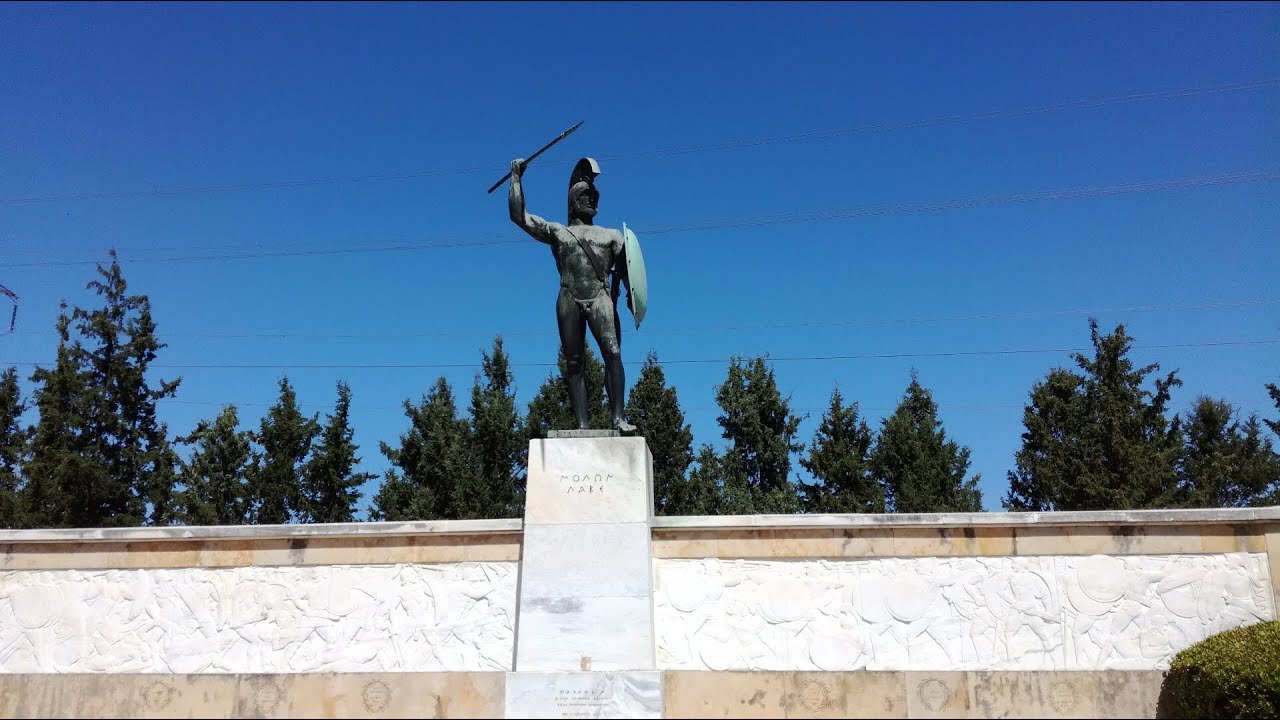
The bronze statue of Leonidas at Thermopylae was erected in 1955, funded by Greek-American donors, modeled on a marble torso excavated near Sparta in 1925. He stands armed, facing toward where the Persians came from. Beneath him, ΜΟΛΩΝ ΛΑΒΕ. Come and take them, the legendary retort to Xerxes' demand that the Greeks surrender their weapons. Herodotus, who records other laconic exchanges, never mentions the phrase. It appears first in Plutarch, writing five centuries after the battle. Historians consider it a later literary embellishment. It reads right, which is probably why it survived.
Across the highway is Kolonos Hill, a low promontory that was always described in the ancient sources as the site of the final stand but wasn't confirmed until 1939, when archaeologist Spyridon Marinatos excavated it and found roughly 100 Persian bronze and iron arrowheads at the summit. That is the physical residue of the last moments. The arrowheads are in Athens now.
The modern stele carrying the Spartan epitaph stands nearby. The words on it are the words Herodotus recorded. Not the ones most people quote, the translation is closer to the Greek than the standard English version. We lie here in obedience to their words.
Not their laws. Their words.
The question that word carries is still unanswered.

I read Gates of Fire at eighteen. I didn't know what I wanted to do with my life, and Pressfield's account of Thermopylae, the brotherhood, the shared sacrifice, the idea that there was a tradition of men who had chosen hardship on purpose, hit me in a way I couldn't fully explain at the time. I joined the Army as an Infantryman not long after.
The movie 300 came out while I was in Infantry basic training at Fort Benning. One of our drill sergeants loved it so much that he convinced a local theater owner to lend him a copy. After weeks of training, exhausted, ground down, not entirely sure we were going to make it, we sat together and watched it. I don't think any of us said much afterward. We didn't need to. We understood, maybe for the first time, what tradition we were trying to join. What standard we were measuring ourselves against. What kind of men had walked this road before us.
That's what Iron Heritage is built on. Not the movie. Not the myth. The standard.
We built this shirt around the monument, not the myth. The design carries the epitaph as Herodotus recorded it, the actual inscription from the actual stone. The Go Tell The Spartans tee is $34.95, available in black, navy, and dark grey heather.