Article: Soldiers of Christ: What the Knights Templar Actually Were
Soldiers of Christ: What the Knights Templar Actually Were
Soldiers of Christ
Not unto us, O Lord. Not unto us.
The Templars were not saints. They were not secret keepers of the Holy Grail. They were not the ancestors of the Freemasons, whatever the Freemasons would like you to believe. They were a military order that existed for 194 years, invented international banking, fought with a discipline that terrified Saladin himself, accumulated wealth that made kings nervous, and were destroyed by a French king who owed them money and couldn't figure out how to pay it back.
Some of them were genuinely remarkable men who took the hardest vow in medieval Christendom and meant every word of it. Some were younger sons looking for a career and an inheritance they'd never get at home. One Grand Master let a personal grudge destroy the Kingdom of Jerusalem. Another died on his feet with an arrow through his armpit rather than leave his post.
They were men. That's actually the more interesting story.
How it started
In 1119, a French knight named Hugh de Payens and a small group of companions approached King Baldwin II of Jerusalem. They wanted to take monastic vows and dedicate themselves to protecting the Christian pilgrims making the dangerous journey from the port at Jaffa to the holy sites in Jerusalem. Baldwin gave them quarters in a captured wing of the Al-Aqsa Mosque on the Temple Mount, the Crusaders believed it stood on the ruins of Solomon's Temple, and the Order had its name.
Popular tradition says there were nine of them. The English chronicler William of Tyre, writing fifty years later, says nine. Another near-contemporary source mentions roughly thirty. Scholars reconcile this as nine knight brothers plus their personal servants and attendants. The identities of all nine aren't definitively established.
The founding was also more politically complicated than the legend suggests. In 1127, Baldwin sent Hugh de Payens to Europe on a diplomatic mission. The primary objectives were securing a marriage to ensure the kingdom's succession and recruiting military reinforcements for an attack on Damascus. Getting papal recognition for the Templars was the third item on the list. The first castle the Order received, Baghras, in the Amanus Mountains, was four hundred miles north of the pilgrim road they supposedly existed to protect. It sat on a strategic military frontier.
This is not a criticism. It's context. The Templars were born into a world of medieval realpolitik, and the men who founded them were operating in that world, not above it. Understanding that makes what came next more honest, not less impressive.
The problem they solved
The medieval church had no framework for a monk who killed people. Monks pray, contemplate, do manual labor. Soldiers fight, drink, and chase women. The idea of combining these vocations was genuinely radical, radical enough that early Templars wrote letters to Bernard of Clairvaux questioning whether their own vocation was spiritually legitimate.
Bernard of Clairvaux was arguably the most influential churchman in Western Christendom. He was connected to the Templars by family, André de Montbard, one of the founders, was his maternal uncle, and he finally agreed to write the theological defense the Order needed.
His argument was this: the knight of Christ kills with tranquil conscience and dies even more tranquilly. In dying he benefits himself, in killing he benefits Christ. The Templar didn't kill a person. He killed evil incarnate. Intent determined morality. If a soldier fought for Christ with righteous purpose, even death in battle was glorious.
Bernard added a qualifier that rarely gets quoted: not that the pagans should be slain if by any other means they can be impeded from persecuting the oppressing the faithful. Killing was a last resort, not a first option.
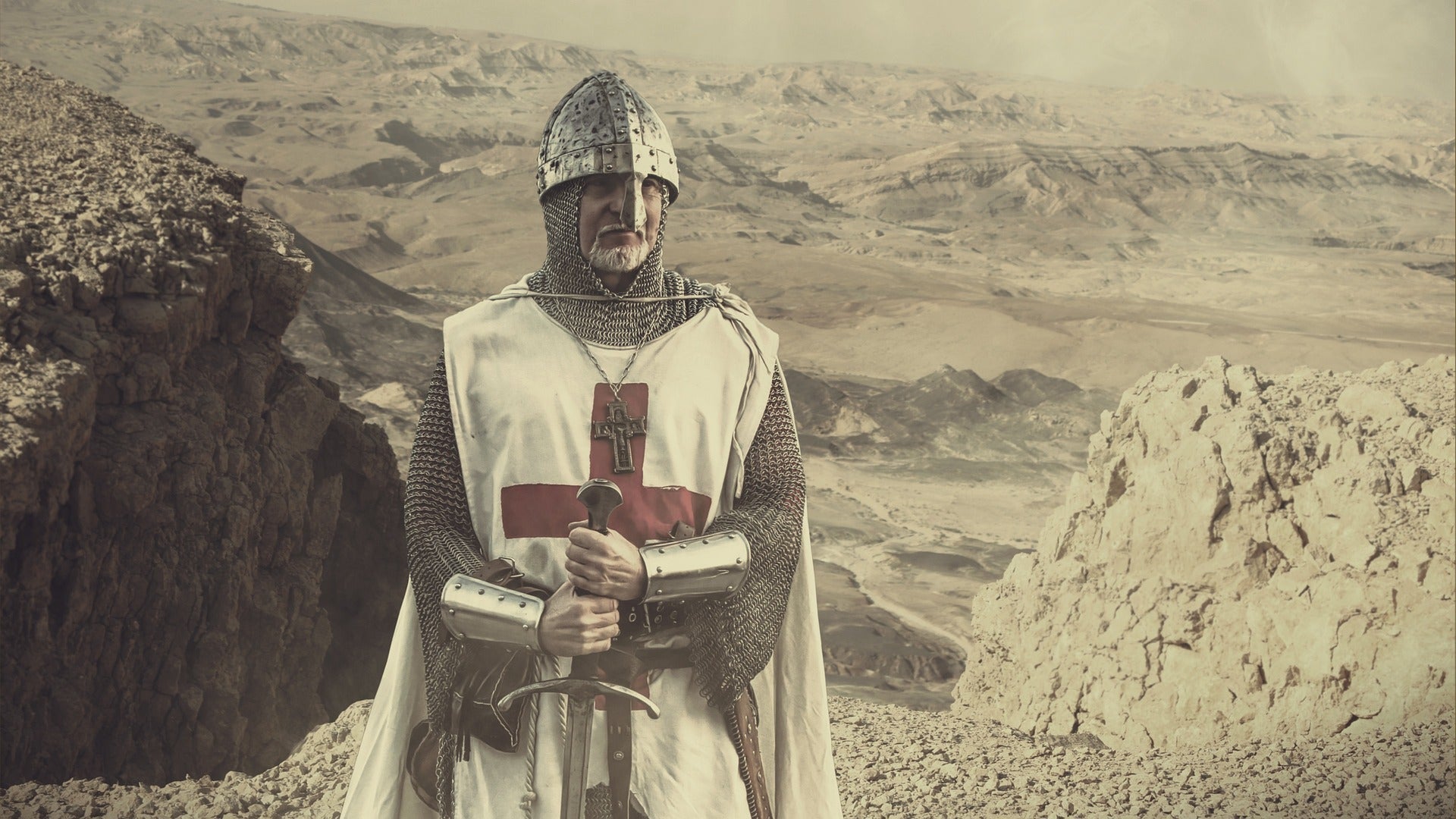
The Council of Troyes in 1129 formalized everything. The Templars received their Rule, 72 clauses that structured every hour of the day. Eight canonical prayer services, starting at 2 AM. Meals eaten in complete silence while scripture was read aloud. Meat three times per week. No hunting. No gambling. No personal property. Not a pair of shoes to their name. The white mantle came from Troyes. The famous red cross was added later by Pope Eugenius III, probably around 1147.
Ten years after that, Pope Innocent II's bull Omne Datum Optimum completed the architecture. The Order answered to no bishop, no king, no local authority, only the Pope. They could keep war spoils. They could accumulate wealth as an institution even though individual members owned nothing. They were a transnational corporation protected directly by Rome.
Nothing like this had existed before. It was the most powerful institutional position in medieval Christendom, and it was the foundation for everything that followed, the banking, the wealth, the power, and eventually the destruction.
What they became
By the late twelfth century the Order had an estimated 15,000 to 20,000 total members across Europe and the Holy Land. Of those, perhaps 1,500 to 2,000 were actual knights. The other 90 percent were sergeants, chaplains, and the vast administrative infrastructure that managed somewhere between 9,000 and 11,000 properties from Ireland to Cyprus.
The individual knight owned nothing. The Order owned everything.
Their financial innovation is arguably their most consequential legacy. A pilgrim could deposit money at a Templar house in London or Paris, receive a letter of credit, and withdraw the equivalent in Jerusalem, the first international financial transfer system in Western history. They managed the French royal treasury under Philip II, reportedly increasing revenues by 120 percent. King John of England deposited the Crown Jewels with them as collateral. The Paris Temple issued quarterly account statements.
The Church prohibited interest on loans, usury. The Templars circumvented this with precise legal engineering. Loan documents recorded only the repayment amount, not the original sum, hiding the interest. They retained rights to production from mortgaged properties. They charged "management fees." They were bankers in everything but name, and they were inventing the infrastructure of medieval finance as they went.
The gap between the individual knight eating in silence on a wooden bench and the institution that was lending 500,000 livres to the King of France was visible, uncomfortable, and real. Contemporary critics noticed it. William of Tyre accused them of "gorging themselves with riches" after abandoning "early humility." Matthew Paris called their revenues an "abyss." The perception of Templar arrogance was widespread, and it was not entirely unfounded. Their papal exemptions bred resentment. Their independent power made kings nervous. Their wealth while claiming poverty was a contradiction they lived with every day, and that contradiction was eventually used to destroy them.

Where they fought, and where they failed
Strip away everything else and the Templars were elite heavy cavalry. Medieval shock troops. They trained and drilled with a cohesion that their era almost never produced, because the same monastic obedience that structured their daily life translated directly to the battlefield. The Rule prohibited retreat unless outnumbered three to one, and even then only by command or if their battle standard, the black and white Beauséant, fell. Violations meant expulsion. Saladin specifically ordered the execution of every captured Templar and Hospitaller after Hattin, offering fifty dinars a head, because he understood: they couldn't be bought, couldn't be ransomed, and wouldn't stop fighting.
Their finest hour came on November 25, 1177. Grand Master Odo de Saint-Amand led eighty Templars alongside Baldwin IV's roughly 375 secular knights against Saladin's force of 26,000 to 30,000. The Battle of Montgisard was a complete rout, Saladin escaped with roughly a tenth of his army. Muslim historians considered this defeat redeemed only by what happened at Hattin ten years later.
Gerard de Ridefort became Grand Master of the Temple carrying a personal grudge that had nothing to do with God. A Flemish adventurer, he had expected to marry a wealthy heiress in exchange for his service to Raymond III of Tripoli. Raymond gave the girl to a rich Pisan merchant instead. Ridefort joined the Templars in the aftermath of that humiliation, and his entire Grand Mastership was shaped by his hatred of Raymond.
Two months before Hattin, at the Springs of Cresson, Ridefort led 130 Templars and Hospitallers against a Muslim force of 7,000. It was near-total annihilation. Only Ridefort and two other Templars survived. This reckless engagement depleted Templar strength before the decisive battle of the war.
At Hattin, Raymond of Tripoli argued against marching the army across waterless terrain to engage Saladin. He was right. His own wife was besieged at Tiberias and he still argued against marching, because he understood that losing the army was worse than losing the city. Ridefort pushed King Guy to march anyway. The historian Malcolm Barber documents that Guy "dared not contradict" Ridefort "for he loved and feared him because he had made him king, and handed over to him the treasure of the King of England." That last detail matters: Ridefort had already violated the Templar obligation to protect deposited funds by handing over Henry II's money to Guy for mercenaries. He needed a victory to justify the theft.
The result: of roughly 20,000 Christians, only about 3,000 infantry escaped. The True Cross was captured. Jerusalem fell three months later. Fifty-two towns and fortifications surrendered within months.
Ridefort was the only Templar to survive Hattin, released in exchange for the fortress at Gaza, violating the same standard his predecessor Odo had honored by dying in prison rather than accept ransom.
This is the institution that wore the white mantle and the red cross. Real men, genuine failures, genuine heroes, the same order. That tension is the story.
The last stand
In May 1291, the Mamluk Sultan al-Ashraf Khalil laid siege to Acre with an estimated 160,000 troops. Grand Master Guillaume de Beaujeu personally led the defense of the most vulnerable sector of wall.
An arrow penetrated his mail under his armpit. He walked away from the fighting. His knights called after him.
His last words: Je ne m'enfuis pas; je suis mort. Voici le coup. I'm not running away. I am dead. Here is the blow. He raised his arm to show the wound.
Survivors retreated to the Templar fortress. When Mamluk troops entered under a flag of truce and immediately attacked women and children, the Templar marshal Peter de Severy ordered the gates closed, trapping nearly 400 attackers inside. On May 28, Mamluk mines collapsed the fortress wall. Thousands rushed in. The weakened structure fell on everyone.
The Templars had no Holy Land left to defend. They withdrew to Cyprus with their remaining resources, their banking operations, and no clear purpose. This instability made them vulnerable. A financially desperate king had been watching them for years.
Philip IV and the end
Philip IV of France had an established method for solving debt problems. In 1291, he arrested Lombard merchants and extracted 250,000 livres. On July 22, 1306, he expelled the Jews of France and confiscated their property, at least 140,000 livres.
In December 1306, after a currency revaluation triggered riots in Paris, Philip reportedly fled to the Paris Temple for refuge. Whatever he observed inside, the decision that followed was not impulsive.
On September 14, 1307, Philip sent sealed orders to every royal agent in France. Do not open until the night of October 12. At dawn on Friday, October 13, 1307, they opened simultaneously across the country.
Grand Master Jacques de Molay had served as a pallbearer at a royal funeral the day before. He had no warning. Royal agents arrested roughly 625 Templars in the first hours.
The charges: heresy, denial of Christ, spitting on the cross, obscene initiation rites, homosexual practices, worship of an idol called Baphomet. "Baphomet" was simply an Old French corruption of "Mahomet", Muhammad, because medieval Europeans wrongly believed Muslims worshipped him as an idol. No physical idol was ever found. Descriptions in different confessions were wildly inconsistent, a bearded head, a head with three faces, a cat, a mummified skull.
The confessions were extracted through torture. Strappado, bound wrists behind the back, hoisted off the ground. Feet coated in lard and held over fire. The rack. Starvation. Sleep deprivation. Of 138 Templars questioned in Paris, 105 admitted denying Christ. A serving brother named Ponsard of Gizy later told the papal commission: "All the accusations were false, but nevertheless if he were tortured again he would say whatever anyone wanted."
The historical consensus is not ambiguous. Malcolm Barber, the leading academic authority on the Templar trial: "It would now be difficult to argue that the Templars were guilty of the accusations made against them." Outside France, where torture wasn't legal, the results were identical everywhere. In England: no confessions. In Cyprus, 76 Templars questioned without torture: none confessed. In Ravenna, where the Archbishop refused torture: all acquitted. The geography of the confessions corresponded exactly to the geography of torture.
Pope Clement V, a Frenchman who had never set foot in Rome, settled at Avignon, and understood very well what happened to popes who crossed Philip, privately investigated and absolved the Templar leadership of heresy. The Chinon Parchment, discovered in the Vatican archives in 2001, documents this absolution in August 1308. Clement then publicly dissolved the Order anyway, two years later, for reasons of "prudence," acknowledging that "definitive proofs were lacking."
When Templars who had confessed began retracting before papal commissioners, Philip's people burned fifty-four of them as relapsed heretics in May 1310. That ended the retractions.
Jacques de Molay's last hour
In March 1314, after seven years of imprisonment, de Molay and three other Templar leaders were brought before Notre-Dame Cathedral to receive their sentence of perpetual imprisonment.
De Molay had already confessed under torture. He had written letters encouraging other Templars to confess. By any ordinary calculation, he had nothing left to gain.
He stood up and recanted.
He declared the Order innocent. He said he had been guilty not of the crimes charged but of "basely betraying the Order to save his own life." Geoffroi de Charney, Master of Normandy, stood with him.
Philip's officials condemned them as relapsed heretics that same afternoon and burned them on the Île des Juifs in the Seine. The pyres were prepared to burn slowly.
Pope Clement V was dead within thirty-three days. Philip IV was dead before the year was out, from a stroke while hunting. His three sons died without male heirs within fourteen years, ending the Capetian dynasty.
What de Molay said from the flames, whether he issued a specific curse or simply died declaring the Order's innocence and God's coming judgment ,varies by source. Medieval chroniclers were not court reporters. But the pattern is documented: an old man who had broken under torture found, at the end, that there was something in him that wouldn't break a second time.
Non nobis, Domine. Non nobis. Sed nomini tuo da gloriam.
Not unto us, Lord. Not unto us. But to your name give the glory.
Whether that phrase was formally the Templar motto in the way popular tradition claims is genuinely uncertain, the historical documentation is thinner than most people realize. The primary sources don't clearly establish it as an official battle cry or inscribed motto. What is not uncertain is that the phrase comes from Psalm 115, that the Templars chanted the entire Psalter as part of their liturgical obligations, that the phrase captures with precision what the Rule asked of every man who wore the white mantle.
Own nothing. Seek no credit. Attribute the victory to God. Die without complaint.
Some of them managed it. The institution consistently fell short. That gap is not a reason to dismiss the ideal. That gap is what makes the story worth telling.

Why it still matters
The Hospitallers survived. They exist today as the Order of Malta. The Teutonic Knights became a secular state in Prussia. The Templars alone were dramatically destroyed, leaving behind an empty space that every subsequent century has tried to fill with conspiracy theories, Freemasonry, Dan Brown novels, and video games.
None of that is the story.
The story is nine men in a conquered mosque in Jerusalem who took a vow nobody had ever taken before, to be both monks and soldiers, to own nothing personally while serving something larger, to fight with discipline and die without credit. The institution built on that vow grew wealthy and powerful and politically entangled and was eventually used as a resource to be liquidated by a king who needed money. The men inside the institution were some of the best fighters in the medieval world, some the worst leaders, some cowards who confessed to things they hadn't done, and one old man who found his spine at the very end.
Militum Christi. Soldiers of Christ.
That's what the name meant. It's what some of them lived.
They took a vow nobody had ever taken before — to own nothing, serve completely, and fight without seeking credit. These shirts carry that name and that standard.